Back to the directoryFind in the timeline
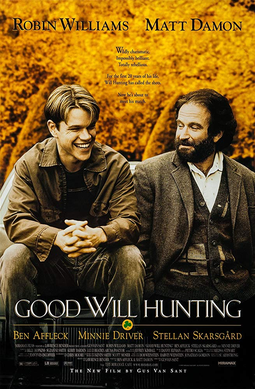

Good Will Hunting
A 1997 drama about Will Hunting, a headstrong working-class genius at a top American university, who after run-ins with the law is sent to a psychology professor and is forced to confront his past.
- Directed or created by
- Gus Van Sant
- Country and language
- United States
- Content notes
- Run-ins with the law and confrontation with the past.
Why this work matters for psychology
It invites questions about talent, class, help-seeking, and how a counseling relationship on screen compares with actual psychotherapy.
Psychological connections
Screen stories illustrate how psychological processes look and feel in narrative form; they are not empirical proof or clinical case studies.
A Counseling Relationship on Screen
The professor who becomes Will's last chance opens discussion about what a helping relationship can offer, while keeping screen drama distinct from clinical practice.
Brilliance and Life Lessons
Will's extraordinary intellect alongside failure at life lessons invites questions about whether problem-solving ability translates across domains.
Portrayal and accuracy limitations
- The film should not be treated as a model of real psychotherapy or diagnosis; the inspected synopsis is promotional.
Questions to watch for
- 1. What does the film suggest about the difference between intellectual ability and life experience?
- 2. What questions does the counselor relationship raise about help-seeking?
In the Psy101 course
OpenStax Section 16.2 supplies an introduction to psychotherapy approaches and the clinician-client relationship; a teaching question is how a dramatized counselor relationship compares with textbook descriptions of treatment, without claiming the film shows actual therapy.
- OpenStax Psychology 2e, section 7.4: What Are Intelligence and Creativity?
- OpenStax Psychology 2e, section 16.2: Types of Treatment
- OpenStax Psychology 2e, Ch. 7: Thinking and Intelligence
- OpenStax Psychology 2e, Ch. 16: Therapy and Treatment
Textbook links show where these concepts sit in an introductory course; they do not study this screen work. See the full topics and course map.
Companion readings and work source
Readings labeled as conceptual companions or contextual references study the psychological topic rather than this screen work.
- [1]Miramax. (n.d.). Good will hunting - official site - miramax. https://www.miramax.com/movie/good-will-hunting/Checked 2026-10-23.Release or archive checkedSelected official synopsis and catalog details inspected; full work not viewed.
- [2]Spielman, R. M., Jenkins, W. J., & Lovett, M. D. (2020). Psychology 2e. OpenStax. https://openstax.org/books/psychology-2e/pages/16-2-types-of-treatment(OpenStax course textbook · Selected passages checked · Checked 2026-10-23).Conceptual Companion (Does Not Study This Work)Conceptual companion: does not study this work. It investigates the underlying psychological construct or textbook topic.Introduces psychotherapy approaches and the clinician-client relationship; it does not study the film.Note: Selected textbook material inspected at the stated access scope. Conceptual companion; it does not study or validate this screen work.
- [3]Spielman, R. M., Jenkins, W. J., & Lovett, M. D. (2020). Psychology 2e. OpenStax. https://openstax.org/books/psychology-2e/pages/7-4-what-are-intelligence-and-creativity(OpenStax course textbook · Selected passages checked · Checked 2026-10-23).Conceptual Companion (Does Not Study This Work)Conceptual companion: does not study this work. It investigates the underlying psychological construct or textbook topic.Surveys theories of intelligence and problem-solving; it does not study the film.Note: Selected textbook material inspected at the stated access scope. Conceptual companion; it does not study or validate this screen work.