Back to the directoryFind in the timeline
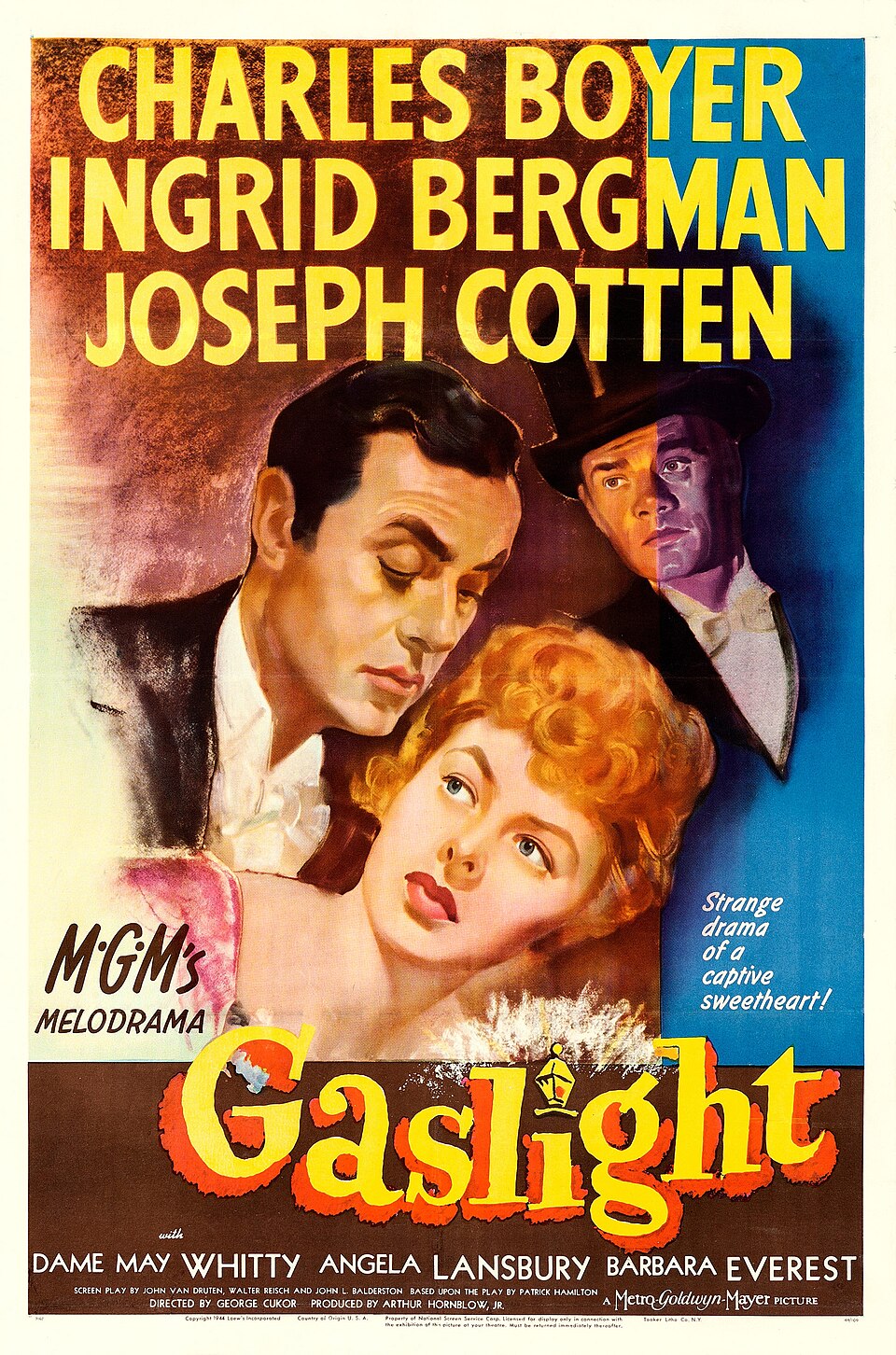

Gaslight
Paula puts aside her singing career for marriage. As life with her husband grows threatening, she struggles to trust her own judgment.
- Directed or created by
- George Cukor
- Content notes
- A threatening marriage and uncertainty about personal judgment.
Why this work matters for psychology
The story raises questions about trust, credibility, and control within a relationship.
Psychological connections
Screen stories illustrate how psychological processes look and feel in narrative form; they are not empirical proof or clinical case studies.
Trust and personal judgment
Paula's uncertainty invites questions about how a person evaluates disputed recollections within a threatening relationship.
Evidence and corroboration
What independent information would help someone evaluate a disputed perception or memory? This is a viewing question, not a finding about the mechanism of abuse.
Portrayal and accuracy limitations
- The fictional relationship can prompt discussion, but it cannot serve as a diagnostic checklist for another person's relationship.
Questions to watch for
- 1. Which events leave Paula unsure of her judgment?
- 2. What would count as independent corroboration when a memory or perception is disputed?
In the Psy101 course
Pair questions about personal judgment and trust with Sections 8.1 (How Memory Functions) and 12.3 (Attitudes and Persuasion); these are conceptual companions, not studies of the film.
- OpenStax Psychology 2e, section 8.1: How Memory Functions
- OpenStax Psychology 2e, section 12.3: Attitudes and Persuasion
- OpenStax Psychology 2e, Ch. 8: Memory
- OpenStax Psychology 2e, Ch. 12: Social Psychology
Textbook links show where these concepts sit in an introductory course; they do not study this screen work. See the full topics and course map.
Companion readings and work source
Readings labeled as conceptual companions or contextual references study the psychological topic rather than this screen work.
- [1](TCM), T. C. M. (1944). Turner classic movies (TCM) official catalog: Gaslight. https://www.tcm.com/watchtcm/titles/166Checked 2026-10-23.Release or archive checkedSelected official synopsis, credits, or catalog details checked; this does not imply a full viewing.
- [2]Spielman, R. M., Jenkins, W. J., & Lovett, M. D. (2020). Psychology 2e. OpenStax. https://openstax.org/books/psychology-2e/pages/12-3-attitudes-and-persuasion(OpenStax course textbook · Selected passages checked · Checked 2026-10-23).Conceptual Companion (Does Not Study This Work)Conceptual companion: does not study this work. It investigates the underlying psychological construct or textbook topic.Explains attitudes, cognitive dissonance and persuasion, including routes to persuasion and sequential-request techniques. These concepts can organize questions about changing beliefs in a story. They do not establish an author’s intent or prove that a fictional change resulted from a named mechanism.Note: Title, objectives, selected beginning/end paragraphs and section headings inspected; full section prose was retrieved, but no whole-section or whole-book read is claimed.
- [3]Spielman, R. M., Jenkins, W. J., & Lovett, M. D. (2020). Psychology 2e. OpenStax. https://openstax.org/books/psychology-2e/pages/8-1-how-memory-functions(OpenStax course textbook · Selected passages checked · Checked 2026-10-23).Conceptual Companion (Does Not Study This Work)Conceptual companion: does not study this work. It investigates the underlying psychological construct or textbook topic.Provides baseline concepts of encoding, storage, and retrieval to contrast with interpersonal manipulation of memory confidence.Note: Official OpenStax section headings and relevant paragraphs inspected; conceptual companion only, does not study this film.