Back to the directoryFind in the timeline
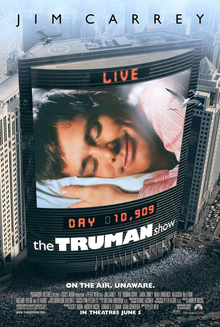

The Truman Show
Truman Burbank believes he is living an ordinary life, while an entire television production organizes the world around him. His town and relationships have been constructed for an audience.
- Directed or created by
- Peter Weir
- Content notes
- Based on the official Paramount synopsis only: lifelong covert television broadcast and staged community deception. Not a full content review.
Why this work matters for psychology
By imagining a protagonist raised inside a scripted town built for broadcast, the film offers a vivid prompt for asking how social consensus, surveillance, and staged environments shape trust and self-concept.
Psychological connections
Screen stories illustrate how psychological processes look and feel in narrative form; they are not empirical proof or clinical case studies.
Self-concept under observation
The premise invites editorial discussion of how self-concept forms when daily life is staged and watched, without asserting clinical conclusions.
Trusting social surroundings
A scripted community offers a prompt to consider conformity and epistemic trust in everyday settings, framed as open questions rather than empirical study findings.
Portrayal and accuracy limitations
- The official Paramount synopsis frames a satirical staged television life; it does not describe empirical research on surveillance, identity, or clinical delusions.
Questions to watch for
- 1. How might a person begin to notice that familiar social surroundings are scripted?
- 2. Which everyday social cues help people decide whom and what to trust?
In the Psy101 course
Pairs the film's staged-community premise with OpenStax Section 12.4 on conformity and social norms; the textbook section is a conceptual companion and does not analyze this film.
- OpenStax Psychology 2e, section 12.4: Conformity, Compliance, and Obedience
- OpenStax Psychology 2e, Ch. 12: Social Psychology
Textbook links show where these concepts sit in an introductory course; they do not study this screen work. See the full topics and course map.
Companion readings and work source
Readings labeled as conceptual companions or contextual references study the psychological topic rather than this screen work.
- [1]Pictures, P. (n.d.). Paramount pictures official page: The truman show. https://www.paramount.com/movies/the-truman-showChecked 2026-10-23.Release or archive checkedSelected official synopsis, credits, or catalog details checked; this does not imply a full viewing.
- [2]Spielman, R. M., Jenkins, W. J., & Lovett, M. D. (2020). Psychology 2e. OpenStax. https://openstax.org/books/psychology-2e/pages/12-4-conformity-compliance-and-obedience(OpenStax course textbook · Selected passages checked · Checked 2026-10-23).Conceptual Companion (Does Not Study This Work)Conceptual companion: does not study this work. It investigates the underlying psychological construct or textbook topic.Examines majority consensus and social norms as conceptual background for questions about engineered social reality.Note: Official OpenStax section headings and relevant paragraphs inspected; conceptual companion only, does not study or validate this film.