Back to the directoryFind in the timeline
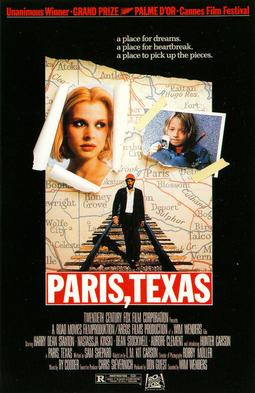

Paris, Texas
Directed by Wim Wenders and written by Sam Shepard, this 1984 character study follows a nearly mute drifter across the American Southwest as he tries to reconnect with his young son in Los Angeles and with his missing wife.
- Directed or created by
- Wim Wenders
- Country and language
- Germany
- Content notes
- Estrangement, disappearance, and family separation as described in the inspected synopsis
Why this work matters for psychology
What might a nearly silent protagonist suggest about what cannot easily be spoken? The film invites questions about reconnection and the shaping of memory, framed as interpretation.
Psychological connections
Screen stories illustrate how psychological processes look and feel in narrative form; they are not empirical proof or clinical case studies.
What remains unsaid
The synopsis emphasizes a nearly mute drifter seeking reconnection; students can ask how a narrative might treat an unspoken past, while keeping the portrayal fictional rather than a claim about memory processes.
Reconnection
The synopsis centers attempts to reconnect with a son and a missing wife; a class can discuss what reconnection may require in such a story, without presupposing specific plot events.
Portrayal and accuracy limitations
- The inspected source is a distributor synopsis; it presents the film as a character study and does not document any psychological condition, and no clinical inference should be drawn from the drifter's silence.
Questions to watch for
- 1. What might make reconnection difficult for a nearly silent character?
- 2. How might landscape and movement shape a character study's mood?
In the Psy101 course
Use the linked textbook concepts as questions for interpreting the premise, rather than as evidence validating its portrayal.
- OpenStax Psychology 2e, section 8.1: How Memory Functions
- OpenStax Psychology 2e, section 9.1: What Is Lifespan Development?
- OpenStax Psychology 2e, Ch. 8: Memory
- OpenStax Psychology 2e, Ch. 9: Lifespan Development
Textbook links show where these concepts sit in an introductory course; they do not study this screen work. See the full topics and course map.
Companion readings and work source
Readings labeled as conceptual companions or contextual references study the psychological topic rather than this screen work.
- [1]Films, J. (n.d.-d). Janus films ; Paris, texas. https://www.janusfilms.com/films/1301Checked 2026-10-23.Release or archive checkedSelected official synopsis and catalog details inspected; full work not viewed.
- [2]Spielman, R. M., Jenkins, W. J., & Lovett, M. D. (2020). Psychology 2e. OpenStax. https://openstax.org/books/psychology-2e/pages/9-1-what-is-lifespan-development(OpenStax course textbook · Selected passages checked · Checked 2026-10-23).Conceptual Companion (Does Not Study This Work)Conceptual companion: does not study this work. It investigates the underlying psychological construct or textbook topic.Conceptual background on lifespan development; does not study the film.Note: Selected textbook material inspected at the stated access scope. Conceptual companion; it does not study or validate this screen work.
- [3]Spielman, R. M., Jenkins, W. J., & Lovett, M. D. (2020). Psychology 2e. OpenStax. https://openstax.org/books/psychology-2e/pages/8-1-how-memory-functions(OpenStax course textbook · Selected passages checked · Checked 2026-10-23).Conceptual Companion (Does Not Study This Work)Conceptual companion: does not study this work. It investigates the underlying psychological construct or textbook topic.Conceptual background on memory functions; does not study the film.Note: Selected textbook material inspected at the stated access scope. Conceptual companion; it does not study or validate this screen work.