Back to the directoryFind in the timeline
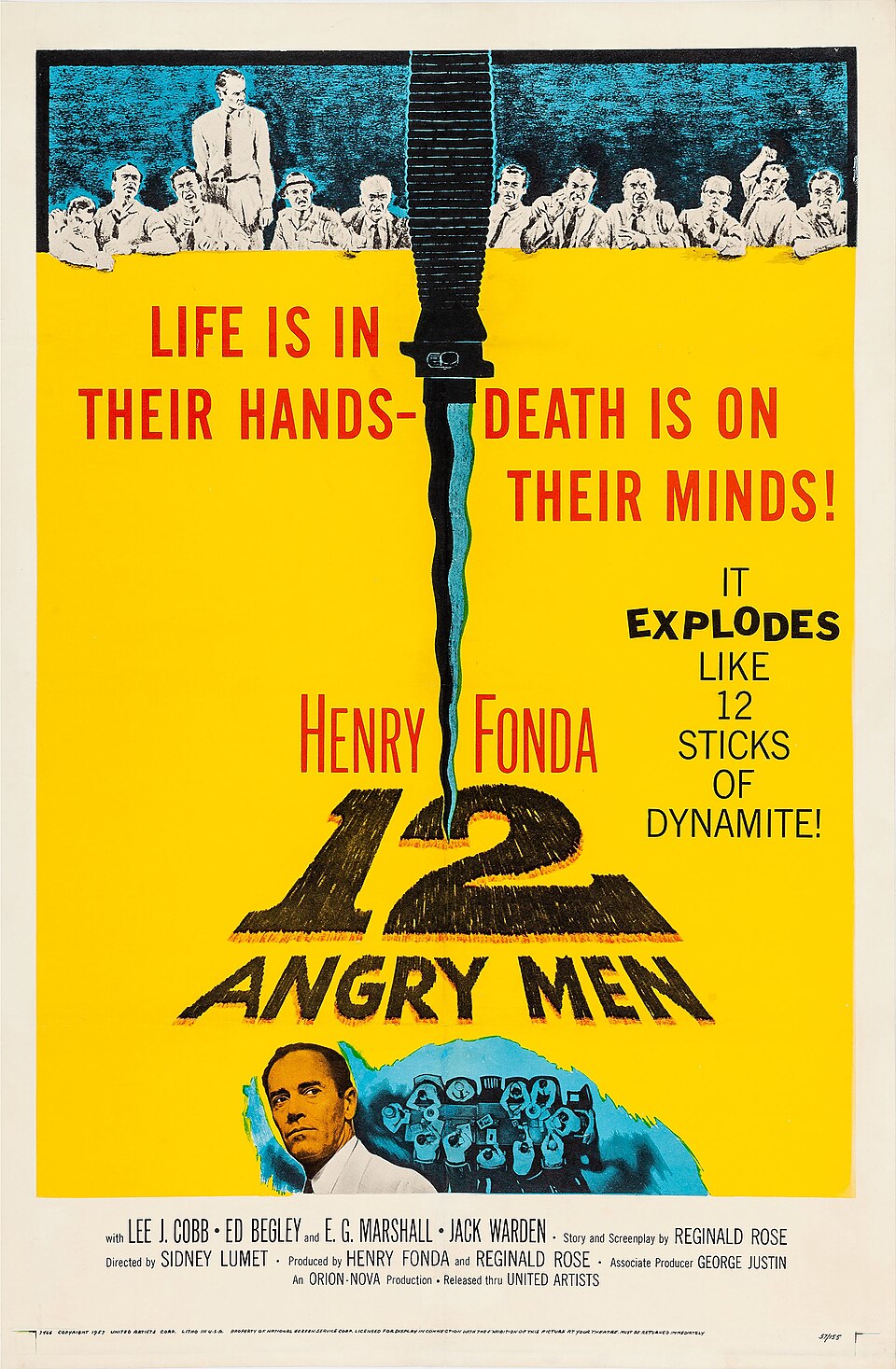

12 Angry Men
One juror resists a quick guilty verdict, forcing the rest of the jury to reconsider a murder charge against a teenager. Deliberation becomes the setting for competing judgments about evidence and the accused.
- Directed or created by
- Sidney Lumet
- Country and language
- United States · English
- Content notes
- Based on the official Criterion synopsis only: murder charge against a teenager, jury deliberation, and racial/ethnic prejudice context. Not a full content review.
Why this work matters for psychology
Set almost entirely inside a locked deliberation room where one dissenter questions a ready majority, the film is a classic reference point for discussing conformity pressure, minority dissent, and prejudice in group judgment.
Psychological connections
Screen stories illustrate how psychological processes look and feel in narrative form; they are not empirical proof or clinical case studies.
Majority pressure and the lone dissenter
The premise centers on a single dissenting juror against a ready majority, inviting discussion of normative conformity pressure and how a consistent dissenting voice can open space for reconsidering a group decision.
Group judgment and prejudiced generalizations
Deliberation in a confined room frames questions about how jurors weigh situational evidence versus dispositional assumptions and group stereotypes.
Portrayal and accuracy limitations
- The inspected Criterion synopsis supports the deliberation premise; it does not establish courtroom procedural accuracy or empirical findings on jury behavior.
- Blessing and Blessing (2015) describe using the film as an introductory psychology classroom capstone activity; their abstract reports one instructional comparison rather than proof of general learning gains or legal realism.
Questions to watch for
- 1. When does majority confidence make it harder for individuals in a group to voice doubt?
- 2. How can you distinguish prejudiced generalizations about a social group from the specific evidence available in a case?
In the Psy101 course
Connects the jury deliberation premise with OpenStax Chapter 12 sections on attribution (12.1), conformity and minority dissent (12.4), and prejudice and discrimination (12.5), alongside Blessing and Blessing's (2015) Teaching of Psychology article on using the film in an introductory course.
- OpenStax Psychology 2e, section 12.1: What Is Social Psychology?
- OpenStax Psychology 2e, section 12.4: Conformity, Compliance, and Obedience
- OpenStax Psychology 2e, section 12.5: Prejudice and Discrimination
- OpenStax Psychology 2e, Ch. 12: Social Psychology
Textbook links show where these concepts sit in an introductory course; they do not study this screen work. See the full topics and course map.
Companion readings and work source
Readings labeled as conceptual companions or contextual references study the psychological topic rather than this screen work.
- [1]Collection, T. C. (1957). The criterion collection: 12 angry men. https://www.criterion.com/films/27871-12-angry-menChecked 2026-10-23.Release or archive checkedSelected official synopsis, credits, or catalog details checked; this does not imply a full viewing.
- [2]Blessing, S. B., & Blessing, J. S. (2014). Using a movie as a capstone activity for the introductory course. Teaching of Psychology, 42(1), 51–55. https://doi.org/10.1177/0098628314562678Consulted source(Peer-reviewed or academic book · Abstract or publisher summary read · Checked 2026-10-23).Studies This WorkDirect commentary or scholarship: this publication specifically discusses or evaluates this screen work.Reports an introductory-psychology classroom capstone activity built around 12 Angry Men.Note: Publisher page opened; author/issue/page metadata and abstract inspected (article body not inspected). Abstract-level evidence about one classroom comparison; not proof of general learning gains or clinical accuracy.
- [3]Spielman, R. M., Jenkins, W. J., & Lovett, M. D. (2020). Psychology 2e. OpenStax. https://openstax.org/books/psychology-2e/pages/12-4-conformity-compliance-and-obedience(OpenStax course textbook · Selected passages checked · Checked 2026-10-23).Conceptual Companion (Does Not Study This Work)Conceptual companion: does not study this work. It investigates the underlying psychological construct or textbook topic.Covers the Asch paradigm, majority pressure, and the role of a dissenting ally in reducing conformity.Note: Official OpenStax section headings and relevant paragraphs inspected; conceptual companion only, does not study or validate this film.
- [4]Spielman, R. M., Jenkins, W. J., & Lovett, M. D. (2020). Psychology 2e. OpenStax. https://openstax.org/books/psychology-2e/pages/12-1-what-is-social-psychology(OpenStax course textbook · Full-text passages checked · Checked 2026-10-23).Conceptual Companion (Does Not Study This Work)Conceptual companion: does not study this work. It investigates the underlying psychological construct or textbook topic.Compares dispositional judgments with situational explanations in social settings.Note: Full rendered OpenStax section prose inspected; conceptual companion only.
- [5]Spielman, R. M., Jenkins, W. J., & Lovett, M. D. (2020). Psychology 2e. OpenStax. https://openstax.org/books/psychology-2e/pages/12-5-prejudice-and-discrimination(OpenStax course textbook · Full-text passages checked · Checked 2026-10-23).Conceptual Companion (Does Not Study This Work)Conceptual companion: does not study this work. It investigates the underlying psychological construct or textbook topic.Distinguishes stereotypes, prejudice, and discrimination and discusses confirmation bias and scapegoating.Note: Full rendered OpenStax section prose inspected; conceptual companion only.