Back to the directoryFind in the timeline
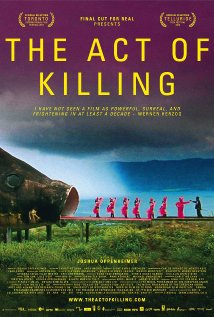

The Act of Killing
Anwar and other former death-squad leaders in Indonesia are invited to stage scenes about killings from 1965 using favorite movie genres. Their performances place personal accounts alongside deliberate reconstruction, raising questions about recollection, self-presentation and the documentary’s method.
- Directed or created by
- Joshua Oppenheimer, Christine Cynn, Anonymous
- Country and language
- Denmark, Norway, United Kingdom · Indonesian
- Content notes
- Mass political violence Death squad participation Staged reenactment of killings
Why this work matters for psychology
The premise raises hard questions about participation, memory, and self-justification in documentary filmmaking, and it asks students to distinguish testimony from evidence.
Psychological connections
Screen stories illustrate how psychological processes look and feel in narrative form; they are not empirical proof or clinical case studies.
Reenactment as participation
Ask how being invited to restage past actions might shape the way participants narrate their own history.
Narrative and recollection
Consider how film genres might frame recollection, and why a reenactment cannot be taken as a straightforward record of events.
Portrayal and accuracy limitations
- Documentary classification does not establish the truth of every depicted account; testimony and staged reenactment require separate scrutiny.
- The production team includes a credited Anonymous co-director, so authorship is partly obscured in the inspected credit list.
Questions to watch for
- 1. What might participants reveal or conceal when asked to dramatize their own past actions?
- 2. How does staging a scene differ from recounting an event, and why does that distinction matter here?
In the Psy101 course
Use the linked textbook concepts as questions for interpreting the premise, rather than as evidence validating its portrayal.
- OpenStax Psychology 2e, section 12.3: Attitudes and Persuasion
- OpenStax Psychology 2e, section 12.4: Conformity, Compliance, and Obedience
- OpenStax Psychology 2e, section 12.5: Prejudice and Discrimination
- OpenStax Psychology 2e, Ch. 12: Social Psychology
Textbook links show where these concepts sit in an introductory course; they do not study this screen work. See the full topics and course map.
Companion readings and work source
Readings labeled as conceptual companions or contextual references study the psychological topic rather than this screen work.
- [1]Danish Film Institute (Det Danske Filminstitut). (n.d.). The act of killing | Danish film institute. https://www.dfi.dk/en/viden-om-film/filmdatabasen/film/act-killingChecked 2026-10-23.Release or archive checkedSelected official synopsis and catalog details inspected; full work not viewed.
- [2]Spielman, R. M., Jenkins, W. J., & Lovett, M. D. (2020). Psychology 2e. OpenStax. https://openstax.org/books/psychology-2e/pages/12-3-attitudes-and-persuasion(OpenStax course textbook · Selected passages checked · Checked 2026-10-23).Conceptual Companion (Does Not Study This Work)Conceptual companion: does not study this work. It investigates the underlying psychological construct or textbook topic.Attitudes and cognitive dissonance at excerpt scope; conceptual framing, not verification of any account.Note: Selected textbook material inspected at the stated access scope. Conceptual companion; it does not study or validate this screen work.
- [3]Spielman, R. M., Jenkins, W. J., & Lovett, M. D. (2020). Psychology 2e. OpenStax. https://openstax.org/books/psychology-2e/pages/12-4-conformity-compliance-and-obedience(OpenStax course textbook · Selected passages checked · Checked 2026-10-23).Conceptual Companion (Does Not Study This Work)Conceptual companion: does not study this work. It investigates the underlying psychological construct or textbook topic.Conformity and obedience at excerpt scope; does not validate historical claims.Note: Selected textbook material inspected at the stated access scope. Conceptual companion; it does not study or validate this screen work.
- [4]Spielman, R. M., Jenkins, W. J., & Lovett, M. D. (2020). Psychology 2e. OpenStax. https://openstax.org/books/psychology-2e/pages/12-5-prejudice-and-discrimination(OpenStax course textbook · Full-text passages checked · Checked 2026-10-23).Conceptual Companion (Does Not Study This Work)Conceptual companion: does not study this work. It investigates the underlying psychological construct or textbook topic.Prejudice and discrimination at full-text scope; conceptual companion only.Note: Selected textbook material inspected at the stated access scope. Conceptual companion; it does not study or validate this screen work.