Back to the directoryFind in the timeline
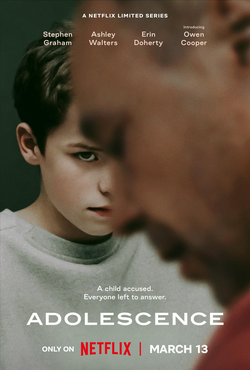

Adolescence
Created by Jack Thorne and Stephen Graham and directed by Philip Barantini, this four-part limited series follows the aftermath when fictional 13-year-old Jamie Miller is accused of murdering a schoolmate, told through perspectives that include his family, police investigators, and a psychologist.
- Directed or created by
- Jack Thorne, Stephen Graham, Philip Barantini
- Trailer link
- Trailer on YouTube (uploaded by Netflix)YouTube watch page uploaded by Netflix, checked 2026-10-23.
- Content notes
- Based on the inspected Netflix title page and Tudum article only: accusation of murder involving a 13-year-old, police custody, and family distress. Not a full content review.
Why this work matters for psychology
By examining a teenage accusation across family, legal, and psychological interviews, the limited series offers a starting point for discussing adolescent peer pressures, family strain, and the boundaries of forensic assessment.
Psychological connections
Screen stories illustrate how psychological processes look and feel in narrative form; they are not empirical proof or clinical case studies.
Early adolescence, family strain, and peer context
Following a 13-year-old suspect and his family across the immediate aftermath of an arrest invites discussion of how early adolescent development interacts with peer norms and family relationships.
Social pressures and investigative interviewing
Moving among family, police, and psychologist perspectives prompts questions about how institutional settings and social pressures shape youth communication without equating a fictional character with a clinical diagnosis.
Portrayal and accuracy limitations
- As documented in the official Netflix Tudum production notes, Jamie Miller is a fictional character and is not based on one real person or event.
- Fictional drama may raise questions about peer and online pressures for discussion, but it does not establish causal proof about social media or represent a clinical diagnosis.
Questions to watch for
- 1. How do the perspectives of family members, police officers, and a psychologist differ when evaluating an adolescent in crisis?
- 2. Why is it important to separate dramatic questions about teenage peer pressures from single-cause claims about youth violence?
In the Psy101 course
Pairs the series' questions about early adolescence and social pressure with OpenStax Section 9.3 (Stages of Development) and Section 12.4 (Conformity, Compliance, and Obedience).
- OpenStax Psychology 2e, section 9.3: Stages of Development
- OpenStax Psychology 2e, section 12.4: Conformity, Compliance, and Obedience
- OpenStax Psychology 2e, Ch. 9: Lifespan Development
- OpenStax Psychology 2e, Ch. 12: Social Psychology
Textbook links show where these concepts sit in an introductory course; they do not study this screen work. See the full topics and course map.
Companion readings and work source
Readings labeled as conceptual companions or contextual references study the psychological topic rather than this screen work.
- [1]Netflix. (n.d.-c). Netflix official title page and tudum article: Adolescence. https://www.netflix.com/title/81756069Checked 2026-10-23.Release or archive checkedSelected official synopsis, credits, or catalog details checked; this does not imply a full viewing.
- [2]Spielman, R. M., Jenkins, W. J., & Lovett, M. D. (2020). Psychology 2e. OpenStax. https://openstax.org/books/psychology-2e/pages/9-3-stages-of-development(OpenStax course textbook · Selected passages checked · Checked 2026-10-23).Conceptual Companion (Does Not Study This Work)Conceptual companion: does not study this work. It investigates the underlying psychological construct or textbook topic.Surveys physical, cognitive and psychosocial development from prenatal life through adulthood. Its headings include attachment, self-concept and social relationships. These are broad contextual connections; the selected passages do not establish a character’s attachment classification or an inevitable developmental course.Note: Title, objectives, selected beginning/end paragraphs and section headings inspected; full section prose was retrieved, but no whole-section or whole-book read is claimed.