Back to the directoryFind in the timeline

Inside Out 2
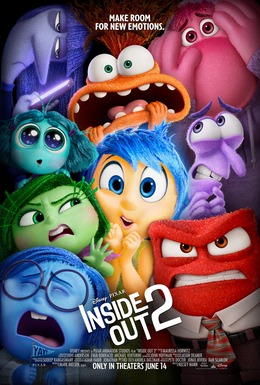
Riley's transition into adolescence brings Anxiety and other newcomers into her inner world. The familiar emotions must adjust as her relationships and sense of self change.
- Directed or created by
- Kelsey Mann
- Trailer link
- Trailer on YouTube (uploaded by Pixar)YouTube watch page uploaded by Pixar, checked 2026-10-23.
- Content notes
- Based on the official page text only: puberty and bodily change; pressure to fit in with high school peers; a character built around anxiety and perfectionism; tryouts; embarrassment and social awkwardness. Not a full content review.
Why this work matters for psychology
The page frames the start of adolescence as a time when new emotions arrive and a sense of self changes quickly, which gives a beginner a concrete way to ask how growing up changes feelings and self-image.
Psychological connections
Screen stories illustrate how psychological processes look and feel in narrative form; they are not empirical proof or clinical case studies.
A mind making room
The page describes Headquarters being demolished to make room for new emotions as Riley becomes a teenager. A viewer might ask whether picturing emotional change as new arrivals helps explain how adolescence changes the way a young person experiences herself, or whether it oversimplifies.
Many feelings, one console
The established emotions have long run Headquarters and are unsure how to feel about Anxiety's arrival. The page describes Anxiety as determined that Riley fit in and avoid mistakes. A viewer might ask whether emotions are better pictured as characters with separate goals or as states a person simply has. This is an editorial question.
Who is Riley becoming?
The page describes Riley's Sense of Self as rapidly changing alongside new friends, tryouts and puberty. A viewer might ask how a person's self-concept could be revised when the social world and the body shift at once.
Portrayal and accuracy limitations
- The primary Pixar source is a promotional character page (supplemented by the Disney release page for date, runtime, and director), so this summary reflects official marketing descriptions rather than a full plot account. No clinical model of emotion or adolescence is presented or evaluated here.
- The page personifies emotions such as Anxiety, Ennui, Envy and Embarrassment as characters with distinct goals and describes teenage apathy and social awkwardness in broad strokes. Treat these as story devices, not as descriptions of anxiety or any condition, and not as a scientific account of emotion.
Questions to watch for
- 1. Which feelings do you think should have the most say when life changes quickly, and why?
- 2. Does Anxiety's aim of helping Riley fit in with her high school peers seem to support or work against her sense of self as you watch?
In the Psy101 course
Connects the film's portrayal of adolescent emotional change with OpenStax Section 10.4 on emotion appraisal, expression, and subjective experience; the textbook section is a conceptual companion and does not analyze this film.
Textbook links show where these concepts sit in an introductory course; they do not study this screen work. See the full topics and course map.
Companion readings and work source
Readings labeled as conceptual companions or contextual references study the psychological topic rather than this screen work.
- [1]Studios, P. A. S. / W. D. (n.d.-b). Pixar animation studios and disney movies official pages: Inside out 2. https://www.pixar.com/inside-out-2Checked 2026-10-23.Release or archive checkedSelected official synopsis, credits, or catalog details checked; this does not imply a full viewing.
- [2]Spielman, R. M., Jenkins, W. J., & Lovett, M. D. (2020). Psychology 2e. OpenStax. https://openstax.org/books/psychology-2e/pages/10-4-emotion(OpenStax course textbook · Selected passages checked · Checked 2026-10-23).Conceptual Companion (Does Not Study This Work)Conceptual companion: does not study this work. It investigates the underlying psychological construct or textbook topic.Covers subjective experience, expression, appraisal, and physiological response in the study of emotion.Note: Official OpenStax section headings and relevant paragraphs inspected; conceptual companion only, does not study or validate this film.