Back to the directoryFind in the timeline

Inside Out
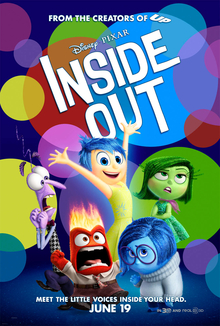
A move to San Francisco unsettles Riley and her family. The film turns her emotions into a group of characters, led by Joy, whose competing priorities shape her response to new surroundings.
- Directed or created by
- Pete Docter
- Trailer link
- Trailer on YouTube (uploaded by Pixar)YouTube watch page uploaded by Pixar, checked 2026-10-23.
- Content notes
- Based on the official page text only: a family relocation for a parent's new job, a young person adjusting to a new school, and conflict among personified emotions. Not a full content review.
Why this work matters for psychology
The film turns everyday feelings into characters who argue over how to respond to a big life change, which gives a beginner a concrete image for asking how emotions relate to decisions and to growing up.
Psychological connections
Screen stories illustrate how psychological processes look and feel in narrative form; they are not empirical proof or clinical case studies.
Do emotions have jobs?
The page gives each emotion a purpose: Joy aims for happiness, Fear watches for danger, Anger pushes for fairness, and Disgust screens out what could harm Riley physically or socially. It also says the other emotions do not fully understand what Sadness is for. Is it useful to picture emotions as specialized advisers, or do real feelings overlap and shift in ways a tidy job list hides? This is an editorial question, not a claim about how emotions are organized.
What changes when a young person's surroundings do?
Riley is uprooted from her Midwest life and has to adjust to a new city, house and school, and the page links that adjustment to turmoil in Headquarters. A viewer might ask how people respond to a major move and what kinds of support could matter. This is a prompt for inquiry, not a research finding.
Which feelings get heard?
Joy tries to keep Riley positive and treats less happy moments as hiccups, while Sadness finds it hard to be positive. A viewer might ask whether the feelings a person listens to shape their sense of who they are, and whether staying positive and acknowledging sadness pull against each other. This is an editorial question, not a tested claim.
Portrayal and accuracy limitations
- The source describes Riley's emotions as characters with distinct goals and personalities, a stylized conceit; it is not a model of how emotions are measured or organized in psychology.
- The page calls Joy Riley's main and most important emotion. That is the story's own narrative emphasis, not a scientific ranking of emotions.
Questions to watch for
- 1. Which of Riley's emotions do you expect to give the most useful advice during a big move, and why?
- 2. What does the control center image leave out about how people actually think and feel?
In the Psy101 course
Connects the film's emotion and memory metaphors with OpenStax sections on how memory functions (8.1) and the components of emotion (10.4); the textbook sections are conceptual companions and do not analyze the film.
- OpenStax Psychology 2e, section 8.1: How Memory Functions
- OpenStax Psychology 2e, section 10.4: Emotion
- OpenStax Psychology 2e, Ch. 8: Memory
- OpenStax Psychology 2e, Ch. 10: Motivation and Emotion
Textbook links show where these concepts sit in an introductory course; they do not study this screen work. See the full topics and course map.
Companion readings and work source
Readings labeled as conceptual companions or contextual references study the psychological topic rather than this screen work.
- [1]Studios, P. A. S. / W. D. (n.d.-a). Pixar animation studios and disney movies official pages: Inside out. https://www.pixar.com/inside-outChecked 2026-10-23.Release or archive checkedSelected official synopsis, credits, or catalog details checked; this does not imply a full viewing.
- [2]Çenesiz, G. Z. (2018). Ters yüz filmi kapsamında duyguların ve beynin i̇şleyişinin i̇ncelenmesi. AYNA Klinik Psikoloji Dergisi, 5(2), 59-71.Consulted source(Peer-reviewed or academic book · Abstract or publisher summary read · Checked 2026-10-23).Studies This WorkDirect commentary or scholarship: this publication specifically discusses or evaluates this screen work.Analyzes the first Inside Out film in relation to emotion and brain portrayals.Note: Official journal page opened; Turkish and English abstracts and citation metadata inspected (PDF body not inspected). A film analysis with proposed therapeutic uses; the abstract does not establish treatment effectiveness or a blanket scientific-accuracy rating.
- [3]Spielman, R. M., Jenkins, W. J., & Lovett, M. D. (2020). Psychology 2e. OpenStax. https://openstax.org/books/psychology-2e/pages/10-4-emotion(OpenStax course textbook · Selected passages checked · Checked 2026-10-23).Conceptual Companion (Does Not Study This Work)Conceptual companion: does not study this work. It investigates the underlying psychological construct or textbook topic.Covers subjective experience, expression, cognitive appraisal, and physiological response, and distinguishes emotion from mood.Note: Official OpenStax section headings and relevant paragraphs inspected; conceptual companion only, does not study or validate this film.
- [4]Spielman, R. M., Jenkins, W. J., & Lovett, M. D. (2020). Psychology 2e. OpenStax. https://openstax.org/books/psychology-2e/pages/8-1-how-memory-functions(OpenStax course textbook · Selected passages checked · Checked 2026-10-23).Conceptual Companion (Does Not Study This Work)Conceptual companion: does not study this work. It investigates the underlying psychological construct or textbook topic.Introduces encoding, storage, and retrieval along with episodic and semantic memory distinctions.Note: Official OpenStax section headings and relevant paragraphs inspected; conceptual companion only, does not study or validate this film.