Back to the directoryFind in the timeline
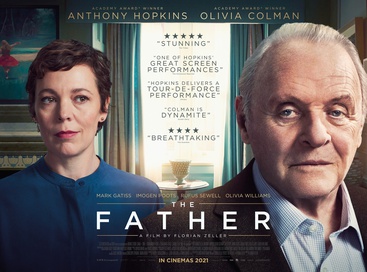

The Father
An older man resists the help his daughter arranges as their everyday lives become harder to manage. The synopsis frames the story through uncertainty about memory, identity, and reality.
- Directed or created by
- Florian Zeller
- Trailer link
- Trailer on YouTube (uploaded by Sony Pictures Classics)YouTube watch page uploaded by Sony Pictures Classics, checked 2026-10-23.
- Content notes
- Based on the official synopsis only: aging, memory and identity, a parent who rejects outside help, and a daughter's grief while her father is still living. Not a full content review.
Why this work matters for psychology
The synopsis centers on one man's memory and on his daughter's grief while he is still alive, so it offers a starting point for thinking about memory, identity and how families approach care.
Psychological connections
Screen stories illustrate how psychological processes look and feel in narrative form; they are not empirical proof or clinical case studies.
What happens when the past keeps shifting?
The synopsis describes the ebb and flow of Anthony's memory and asks how much of his identity and past he can hold on to. A viewer might ask how memory and a sense of reality relate in this story, while remembering that a fictional portrayal is not evidence about real memory.
Is identity more than memory?
Anthony is described as mischievous and defiant, and the synopsis asks how much of his identity he can keep. A viewer might ask how a person's identity could be understood beyond memory alone, and whose account of a person should count if accounts differ.
How does care change a family relationship?
The synopsis says Anne cannot make daily visits and asks how she copes while grieving a father who is still alive. A viewer might ask about the strain on someone arranging care for a parent, and about grief that begins before a death. These are editorial prompts, not clinical guidance or measured findings.
Portrayal and accuracy limitations
- The official synopsis frames Anthony's experience around memory and a changing grip on reality; it is a dramatic narrative, not a clinical assessment or caregiving guide.
- The page leads with awards and review excerpts and describes the film as true to real life. Those are promotional statements, not assessments made here. This entry draws only on the short synopsis and cannot assess performance, clinical accuracy or the full story. Note on release date convention: the British Council catalogue and Sundance Institute record the 2020 Sundance world premiere, while Sony Pictures Classics lists its 2021 distribution release.
Questions to watch for
- 1. Whose point of view do you feel closest to as you watch, and what draws you there?
- 2. What would you want to learn about memory and aging before or after watching?
In the Psy101 course
Pairs the synopsis's questions about memory and personal identity with OpenStax Section 8.1 on encoding, storage, and retrieval; the textbook section is a conceptual companion and does not examine this film.
Textbook links show where these concepts sit in an introductory course; they do not study this screen work. See the full topics and course map.
Companion readings and work source
Readings labeled as conceptual companions or contextual references study the psychological topic rather than this screen work.
- [1]Sony Pictures Classics / British Council Film. (n.d.). Sony pictures classics official page and British council film catalog: The father. https://www.sonyclassics.com/film/thefatherChecked 2026-10-23.Release or archive checkedSelected official synopsis, credits, or catalog details checked; this does not imply a full viewing.
- [2]Creagh, T. (2026). Contemporary memory loss narratives: Romanticized or realistic? CINEJ cinema journal, 14(1), 678-709.Consulted source(Peer-reviewed or academic book · Abstract or publisher summary read · Checked 2026-10-23).Studies This WorkDirect commentary or scholarship: this publication specifically discusses or evaluates this screen work.Proposes an analytical framework for memory-loss portrayals in cinema and includes The Father and Memento in its listed filmography.Note: Journal landing page metadata, abstract, references, and filmography inspected (full PDF not read); filmography confirms inclusion of The Father without asserting a specific clinical verdict from the unread article body.
- [4]Schacter, D. L. (1996). Searching for memory: The brain, the mind, and the past. Basic Books.Consulted source(Peer-reviewed or academic book · Bibliographic catalog record checked · Checked 2026-10-23).Conceptual Companion (Does Not Study This Work)Conceptual companion: does not study this work. It investigates the underlying psychological construct or textbook topic.A metadata-only scholarly book reference for considering memory as a topic. Its title and catalog contents informed this editorial pairing; the book was not read and does not study this screen work.Note: Author Harvard publication record and Wellcome first-edition catalogue/contents (https://wellcomecollection.org/works/mzv4xjxk) opened; book text not read.
- [3]Spielman, R. M., Jenkins, W. J., & Lovett, M. D. (2020). Psychology 2e. OpenStax. https://openstax.org/books/psychology-2e/pages/8-1-how-memory-functions(OpenStax course textbook · Selected passages checked · Checked 2026-10-23).Conceptual Companion (Does Not Study This Work)Conceptual companion: does not study this work. It investigates the underlying psychological construct or textbook topic.Introduces encoding, storage, and retrieval processes along with episodic and semantic memory distinctions.Note: Official OpenStax section headings and relevant paragraphs inspected; conceptual companion only, does not study or validate this film.