Back to the directoryFind in the timeline
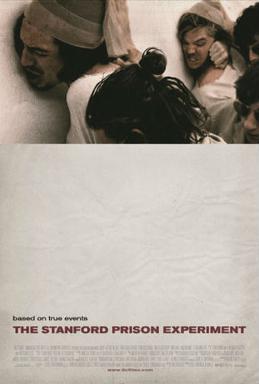

The Stanford Prison Experiment
A 2015 drama starring Billy Crudup as Stanford professor Philip Zimbardo, depicting the 1971 study in which 24 student volunteers were assigned as prisoners and guards in a simulated jail.
- Directed or created by
- Kyle Patrick Alvarez
- Country and language
- United States
- Trailer link
- Trailer on YouTube (uploaded by Independent Film Company)YouTube watch page uploaded by Independent Film Company, checked 2026-10-23.
- Content notes
- Simulated prison setting and depiction of a psychological study.
Why this work matters for psychology
It invites questions about role assignment, institutional power, and what ethical safeguards research with human participants requires.
Psychological connections
Screen stories illustrate how psychological processes look and feel in narrative form; they are not empirical proof or clinical case studies.
Roles and Confinement
The assignment of students to prisoner and guard roles opens discussion about how roles and settings might shape conduct, while avoiding any claim that roles inevitably determine behavior.
A Study Retold
A dramatized research setting invites questions about informed consent, oversight, and participant protection, without evaluating the historical experiment's validity.
Portrayal and accuracy limitations
- The film is a dramatization with reported close involvement of Zimbardo; a drama cannot establish the scientific validity of the 1971 events or of claims about role effects.
Questions to watch for
- 1. How might assigning people to roles raise ethical questions for researchers?
- 2. What does a dramatized study leave open about how conduct and setting relate?
In the Psy101 course
OpenStax Section 2.4 supplies IRB, informed consent, and participant-protection concepts; a teaching question is what safeguards a modern study of role behavior would need, without treating the film as evidence.
- OpenStax Psychology 2e, section 2.4: Ethics
- OpenStax Psychology 2e, section 12.2: Self-presentation
- OpenStax Psychology 2e, section 12.4: Conformity, Compliance, and Obedience
- OpenStax Psychology 2e, Ch. 2: Psychological Research
- OpenStax Psychology 2e, Ch. 12: Social Psychology
Textbook links show where these concepts sit in an introductory course; they do not study this screen work. See the full topics and course map.
Companion readings and work source
Readings labeled as conceptual companions or contextual references study the psychological topic rather than this screen work.
- [1]Independent Film Company (IFC in Theaters LLC). (n.d.). The Stanford prison experiment | championing independent movies | independent film company. https://www.independentfilmco.com/films/the-stanford-prison-experimentChecked 2026-10-23.Release or archive checkedSelected official synopsis and catalog details inspected; full work not viewed.
- [2]Spielman, R. M., Jenkins, W. J., & Lovett, M. D. (2020). Psychology 2e. OpenStax. https://openstax.org/books/psychology-2e/pages/12-2-self-presentation(OpenStax course textbook · Selected passages checked · Checked 2026-10-23).Conceptual Companion (Does Not Study This Work)Conceptual companion: does not study this work. It investigates the underlying psychological construct or textbook topic.Introduces social roles and norms and includes discussion of methodological criticisms; it does not study the film.Note: Selected textbook material inspected at the stated access scope. Conceptual companion; it does not study or validate this screen work.
- [3]Spielman, R. M., Jenkins, W. J., & Lovett, M. D. (2020). Psychology 2e. OpenStax. https://openstax.org/books/psychology-2e/pages/2-4-ethics(OpenStax course textbook · Selected passages checked · Checked 2026-10-23).Conceptual Companion (Does Not Study This Work)Conceptual companion: does not study this work. It investigates the underlying psychological construct or textbook topic.Introduces IRBs, informed consent, and debriefing; it does not study the film.Note: Selected textbook material inspected at the stated access scope. Conceptual companion; it does not study or validate this screen work.
- [4]Spielman, R. M., Jenkins, W. J., & Lovett, M. D. (2020). Psychology 2e. OpenStax. https://openstax.org/books/psychology-2e/pages/12-4-conformity-compliance-and-obedience(OpenStax course textbook · Selected passages checked · Checked 2026-10-23).Conceptual Companion (Does Not Study This Work)Conceptual companion: does not study this work. It investigates the underlying psychological construct or textbook topic.Covers conformity, compliance, and obedience to authority; it does not study the film.Note: Selected textbook material inspected at the stated access scope. Conceptual companion; it does not study or validate this screen work.