Back to the directoryFind in the timeline
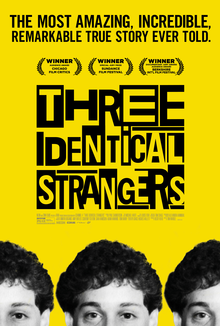

Three Identical Strangers
Three nineteen-year-olds in New York discover in 1980 that they are identical triplets separated at birth. The documentary follows their reunion and the further questions it raises about their lives and separation.
- Directed or created by
- Tim Wardle
- Content notes
- Separation of siblings and disclosure of a disturbing secret.
Why this work matters for psychology
A reunion after separate childhoods invites questions about identity, development and what shared heredity can and cannot tell us about a person. It also opens discussion of disclosure and consent without assuming the documentary establishes an experimental finding.
Psychological connections
Screen stories illustrate how psychological processes look and feel in narrative form; they are not empirical proof or clinical case studies.
Separated and Reunited
The triplets' separation and reunion raise open questions about how development and environment might interact, without settling any nature-versus-nurture debate.
Consent and disclosure
If a separation at birth were connected to research, what obligations of consent, welfare and disclosure would apply? Treat this as a conditional ethics question, not a factual conclusion established by the inspected synopsis.
Portrayal and accuracy limitations
- Documentary testimony and editing should be distinguished from experimental evidence; the film does not by itself establish scientific conclusions about heredity or any study.
Questions to watch for
- 1. What questions about identity does a separated-at-birth reunion raise?
- 2. If a separation at birth were connected to research, what consent and disclosure obligations would apply?
In the Psy101 course
OpenStax Section 9.1 supplies an introduction to developmental domains and the nature-versus-nurture debate; a teaching question is how a documentary account of separated siblings engages that debate, without treating testimony as experimental proof.
- OpenStax Psychology 2e, section 2.4: Ethics
- OpenStax Psychology 2e, section 9.1: What Is Lifespan Development?
- OpenStax Psychology 2e, Ch. 2: Psychological Research
- OpenStax Psychology 2e, Ch. 9: Lifespan Development
Textbook links show where these concepts sit in an introductory course; they do not study this screen work. See the full topics and course map.
Companion readings and work source
Readings labeled as conceptual companions or contextual references study the psychological topic rather than this screen work.
- [1]Raw TV Ltd. (Production Company). (n.d.). Three identical strangers - raw TV. https://www.raw.co.uk/three-identical-strangersChecked 2026-10-23.Release or archive checkedSelected official synopsis and catalog details inspected; full work not viewed.
- [2]Spielman, R. M., Jenkins, W. J., & Lovett, M. D. (2020). Psychology 2e. OpenStax. https://openstax.org/books/psychology-2e/pages/2-4-ethics(OpenStax course textbook · Selected passages checked · Checked 2026-10-23).Conceptual Companion (Does Not Study This Work)Conceptual companion: does not study this work. It investigates the underlying psychological construct or textbook topic.Introduces IRBs, informed consent, and ethical oversight; it does not study the documentary.Note: Selected textbook material inspected at the stated access scope. Conceptual companion; it does not study or validate this screen work.
- [3]Spielman, R. M., Jenkins, W. J., & Lovett, M. D. (2020). Psychology 2e. OpenStax. https://openstax.org/books/psychology-2e/pages/9-1-what-is-lifespan-development(OpenStax course textbook · Selected passages checked · Checked 2026-10-23).Conceptual Companion (Does Not Study This Work)Conceptual companion: does not study this work. It investigates the underlying psychological construct or textbook topic.Introduces developmental domains and the nature-versus-nurture debate; it does not study the documentary.Note: Selected textbook material inspected at the stated access scope. Conceptual companion; it does not study or validate this screen work.