Back to the directoryFind in the timeline
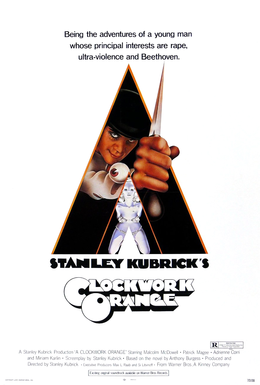

A Clockwork Orange
A violent young gang leader is imprisoned and subjected to an institutional conditioning procedure intended to make violence repulsive to him. The premise raises questions about learning, punishment, personal choice and the limits of behavior modification.
- Directed or created by
- Stanley Kubrick
- Content notes
- Violence described in official synopsis Imprisonment Institutional conditioning
Why this work matters for psychology
The film invites students to ask how institutions justify changing a person, who consents, and what the story leaves unresolved about coercion and its aftermath in a fictional world.
Psychological connections
Screen stories illustrate how psychological processes look and feel in narrative form; they are not empirical proof or clinical case studies.
Consent inside an institution
Consider who is positioned to agree to the fictional procedure and how the setting of confinement complicates any idea of voluntary participation.
Fiction is not treatment evidence
Ask how the film frames the conditioning as a cure and what interpretive work the word cure does when the outcome remains uncertain.
Portrayal and accuracy limitations
- The official synopsis and catalog notes are promotional and archival summaries, so the film's stylistic treatment of violence and institutional care cannot be judged from this packet.
- A fictional conditioning procedure should not be read as a depiction of any real therapeutic method.
Questions to watch for
- 1. What reasons might the institution offer for its procedure, and who benefits from those reasons?
- 2. How does the film's own language of cure shape the way viewers read what happens to the protagonist?
In the Psy101 course
Use the linked textbook concepts as questions for interpreting the premise, rather than as evidence validating its portrayal.
- OpenStax Psychology 2e, section 2.4: Ethics
- OpenStax Psychology 2e, section 6.2: Classical Conditioning
- OpenStax Psychology 2e, Ch. 2: Psychological Research
- OpenStax Psychology 2e, Ch. 6: Learning
Textbook links show where these concepts sit in an introductory course; they do not study this screen work. See the full topics and course map.
Companion readings and work source
Readings labeled as conceptual companions or contextual references study the psychological topic rather than this screen work.
- [1]Inc, W. Bros. E. (1971, December 19). A clockwork orange. https://www.warnerbros.com/movies/clockwork-orangeChecked 2026-10-23.Release or archive checkedSelected official synopsis and catalog details inspected; full work not viewed.
- [2]Spielman, R. M., Jenkins, W. J., & Lovett, M. D. (2020). Psychology 2e. OpenStax. https://openstax.org/books/psychology-2e/pages/6-2-classical-conditioning(OpenStax course textbook · Selected passages checked · Checked 2026-10-23).Conceptual Companion (Does Not Study This Work)Conceptual companion: does not study this work. It investigates the underlying psychological construct or textbook topic.Supplies vocabulary for learned associations and extinction; it does not study the film and cannot validate the fictional procedure.Note: Selected textbook material inspected at the stated access scope. Conceptual companion; it does not study or validate this screen work.
- [3]Spielman, R. M., Jenkins, W. J., & Lovett, M. D. (2020). Psychology 2e. OpenStax. https://openstax.org/books/psychology-2e/pages/2-4-ethics(OpenStax course textbook · Selected passages checked · Checked 2026-10-23).Conceptual Companion (Does Not Study This Work)Conceptual companion: does not study this work. It investigates the underlying psychological construct or textbook topic.Frames informed consent and participant protection as questions, not as a verdict on the film's depicted institution.Note: Selected textbook material inspected at the stated access scope. Conceptual companion; it does not study or validate this screen work.