Back to the directoryFind in the timeline
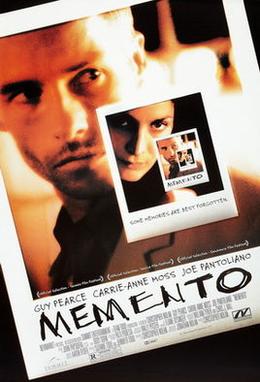

Memento
Leonard Shelby pursues his wife's killer while struggling to form new memories. He uses handwritten reminders, instant photographs, and body markings to track information; the film arranges events in reverse order.
- Directed or created by
- Christopher Nolan
- Country and language
- United States
- Content notes
- Based on the inspected Viennale synopsis and Baxendale (2004) passages only: murder revenge premise and severe post-injury memory impairment. Not a full content review.
Why this work matters for psychology
Told in reverse sequence while following a protagonist who relies on handwritten notes and photographs to bridge memory gaps, the film offers a striking entry point for discussing anterograde memory loss and external memory aids.
Psychological connections
Screen stories illustrate how psychological processes look and feel in narrative form; they are not empirical proof or clinical case studies.
External memory aids and anterograde loss
Leonard's notes, Polaroids, and tattoos provide an editorial prompt to discuss how people offload remembering onto external cues, while clinical commentary (Baxendale, 2004) highlights how the portrayal preserves pre-injury identity alongside severe new-learning deficits.
Reconstructing sequence from fragments
A backward narrative structure invites questions about how chronological order and context shape reasoning and causal interpretation.
Portrayal and accuracy limitations
- The Viennale synopsis uses everyday language for memory difficulty rather than a formal neuropsychological assessment. This profile uses its 116-minute festival listing; that value is not a universal edition runtime.
- Clinical neuropsychologist Sallie Baxendale (2004, BMJ) discusses Memento among honorable exceptions to common movie amnesia myths because the character retains personal identity, shows minimal retrograde loss, and faces severe everyday new-learning deficits; however, Baxendale's 2004 essay is a selective review rather than a universal clinical certification of every plot detail.
Questions to watch for
- 1. How do written notes and photographs change what a person can track when new memories fade quickly?
- 2. What does presenting events in reverse order ask viewers to notice about cause, effect, and context?
In the Psy101 course
Compare the fictional memory aids with Sections 8.1 and 8.3. Baxendale discusses screen portrayals at the selected-passage scope recorded below; Creagh lists the film in a filmography inspected at abstract scope. Neither pairing certifies every plot detail.
- OpenStax Psychology 2e, section 8.1: How Memory Functions
- OpenStax Psychology 2e, section 8.3: Problems with Memory
- OpenStax Psychology 2e, Ch. 8: Memory
Textbook links show where these concepts sit in an introductory course; they do not study this screen work. See the full topics and course map.
Companion readings and work source
Readings labeled as conceptual companions or contextual references study the psychological topic rather than this screen work.
- [1]Viennale. (2000). Viennale (Vienna international film festival) archive: Memento. https://www.viennale.at/en/films/mementoChecked 2026-10-23.Release or archive checkedSelected official synopsis, credits, or catalog details checked; this does not imply a full viewing.
- [2]Baxendale, S. (2004). Memories aren’t made of this: Amnesia at the movies. BMJ (Clinical Research Ed.), 329(7480), 1480–1483. https://doi.org/10.1136/bmj.329.7480.1480Consulted source(Peer-reviewed or academic book · Selected passages checked · Checked 2026-10-23).Studies This WorkDirect commentary or scholarship: this publication specifically discusses or evaluates this screen work.Specifically discusses Memento under 'Honourable exceptions' to cinematic amnesia myths, noting its depiction of retained identity, minimal retrograde loss, and severe everyday new-learning difficulty.Note: Indexed PMC full-text passages inspected (direct BMJ/PMC open showed browser challenge). A 2004 clinical review of selected portrayals, not a universal clinical accuracy certification.
- [3]Creagh, T. (2026). Contemporary memory loss narratives: Romanticized or realistic? CINEJ cinema journal, 14(1), 678-709.Consulted source(Peer-reviewed or academic book · Abstract or publisher summary read · Checked 2026-10-23).Studies This WorkDirect commentary or scholarship: this publication specifically discusses or evaluates this screen work.Proposes a framework for evaluating memory-loss narratives in film and includes Memento in its listed filmography.Note: Journal landing page metadata, abstract, references, and filmography inspected (full PDF not read); confirms inclusion of Memento without asserting a specific conclusion from the unread PDF body.
- [6]Schacter, D. L. (1996). Searching for memory: The brain, the mind, and the past. Basic Books.Consulted source(Peer-reviewed or academic book · Bibliographic catalog record checked · Checked 2026-10-23).Conceptual Companion (Does Not Study This Work)Conceptual companion: does not study this work. It investigates the underlying psychological construct or textbook topic.A metadata-only scholarly book reference for considering memory as a topic. Its title and catalog contents informed this editorial pairing; the book was not read and does not study this screen work.Note: Author Harvard publication record and Wellcome first-edition catalogue/contents (https://wellcomecollection.org/works/mzv4xjxk) opened; book text not read.
- [4]Spielman, R. M., Jenkins, W. J., & Lovett, M. D. (2020). Psychology 2e. OpenStax. https://openstax.org/books/psychology-2e/pages/8-1-how-memory-functions(OpenStax course textbook · Selected passages checked · Checked 2026-10-23).Conceptual Companion (Does Not Study This Work)Conceptual companion: does not study this work. It investigates the underlying psychological construct or textbook topic.Introduces encoding, storage, and retrieval processes that frame questions about external notes and memory consolidation.Note: Official OpenStax section headings and relevant paragraphs inspected; conceptual companion only, does not study or validate this film.
- [5]Spielman, R. M., Jenkins, W. J., & Lovett, M. D. (2020). Psychology 2e. OpenStax. https://openstax.org/books/psychology-2e/pages/8-3-problems-with-memory(OpenStax course textbook · Selected passages checked · Checked 2026-10-23).Conceptual Companion (Does Not Study This Work)Conceptual companion: does not study this work. It investigates the underlying psychological construct or textbook topic.Covers different forms of amnesia, eyewitness memory, suggestion, misinformation, forgetting and interference. These topics provide reading context for stories about uncertain recollection. The selected passages do not certify a film’s clinical accuracy or turn inconsistent testimony into a diagnosed memory disorder.Note: Title, objectives, selected beginning/end paragraphs and section headings inspected; full section prose was retrieved, but no whole-section or whole-book read is claimed.