Back to the directoryFind in the timeline
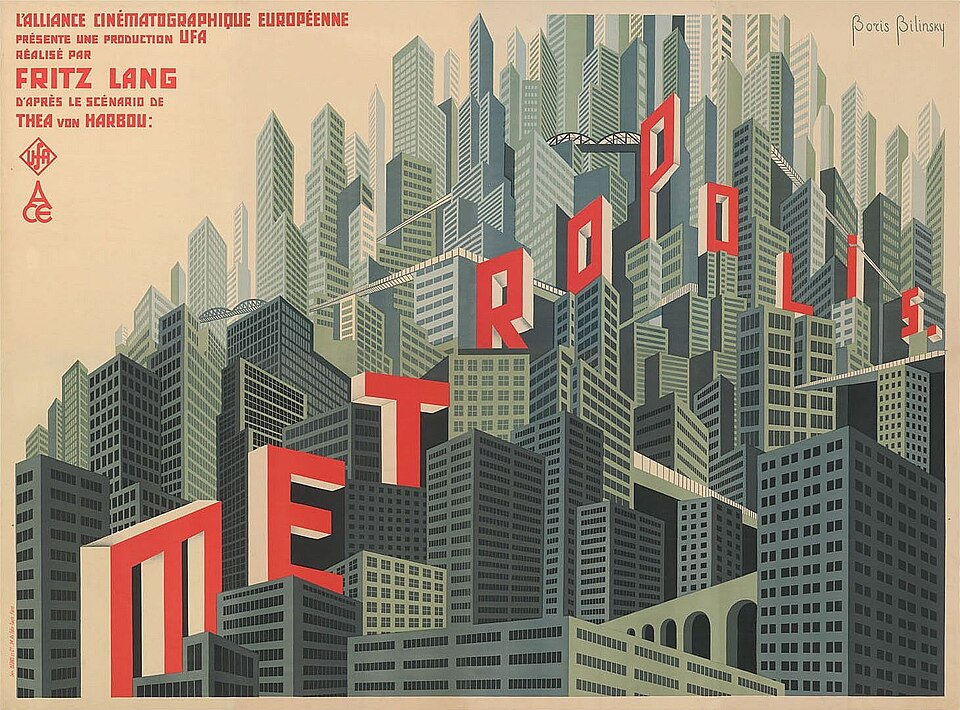

Metropolis
A powerful businessman in a future city recruits a scientist to suppress labor reformers.
- Directed or created by
- Fritz Lang
- Content notes
- Social control and conflict over labor reform.
Why this work matters for psychology
The city's hierarchy offers a starting point for discussing authority, group identity, and technology.
Psychological connections
Screen stories illustrate how psychological processes look and feel in narrative form; they are not empirical proof or clinical case studies.
Groups and authority
The attempt to suppress labor reform invites questions about how authority defines a group's interests and its opponents.
Roles and social position
How might a person's position in the city affect the way conflict over reform is interpreted? The film is a fictional prompt for this question.
Portrayal and accuracy limitations
- This dystopian story is a representation of social conflict, rather than empirical evidence about crowd behavior.
Questions to watch for
- 1. How does the story represent the interests of different groups in the city?
- 2. Which actions encourage or obstruct understanding across social positions?
In the Psy101 course
Pairs the film's depiction of class division with OpenStax Section 12.5 on group boundaries and prejudice alongside Chapter 13 (Industrial-Organizational Psychology).
- OpenStax Psychology 2e, section 12.5: Prejudice and Discrimination
- OpenStax Psychology 2e, section 13.3: Organizational Psychology: The Social Dimension of Work
- OpenStax Psychology 2e, Ch. 12: Social Psychology
- OpenStax Psychology 2e, Ch. 13: Industrial-Organizational Psychology
Textbook links show where these concepts sit in an introductory course; they do not study this screen work. See the full topics and course map.
Companion readings and work source
Readings labeled as conceptual companions or contextual references study the psychological topic rather than this screen work.
- [1](TCM), T. C. M. (1927). Turner classic movies (TCM) official catalog: Metropolis. https://www.tcm.com/watchtcm/titles/5892Checked 2026-10-23.Reference catalog checkedCatalog details and an indexed synopsis checked; the full page was region restricted.
- [2]Spielman, R. M., Jenkins, W. J., & Lovett, M. D. (2020). Psychology 2e. OpenStax. https://openstax.org/books/psychology-2e/pages/13-3-organizational-psychology-the-social-dimension-of-work(OpenStax course textbook · Selected passages checked · Checked 2026-10-23).Conceptual Companion (Does Not Study This Work)Conceptual companion: does not study this work. It investigates the underlying psychological construct or textbook topic.Introduces organizational psychology through job satisfaction, leadership, teamwork, culture and workplace relationships. Its concepts can frame discussion of institutional settings in films. Selected textbook passages do not validate a screen organization’s portrayal or justify a clinical account of worker behavior.Note: Title, objectives, selected beginning/end paragraphs and section headings inspected; full section prose was retrieved, but no whole-section or whole-book read is claimed.
- [3]Spielman, R. M., Jenkins, W. J., & Lovett, M. D. (2020). Psychology 2e. OpenStax. https://openstax.org/books/psychology-2e/pages/12-5-prejudice-and-discrimination(OpenStax course textbook · Full-text passages checked · Checked 2026-10-23).Conceptual Companion (Does Not Study This Work)Conceptual companion: does not study this work. It investigates the underlying psychological construct or textbook topic.Discusses in-group bias and group boundaries as a conceptual vocabulary for examining stratified social systems.Note: Full rendered OpenStax section prose inspected; conceptual companion only, does not study this film.