Back to the directoryFind in the timeline
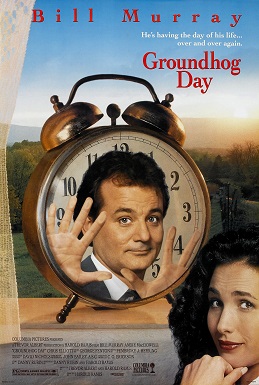

Groundhog Day
A weather presenter covering a Pennsylvania celebration becomes stuck in a day that repeatedly restarts. The comic premise turns repetition into a question about motivation and change.
- Directed or created by
- Harold Ramis
- Content notes
- Based on the official Sony Pictures synopsis only: small-town blizzard and repeated-day romantic comedy premise. Not a full content review.
Why this work matters for psychology
The comic time-loop premise provides an approachable thought experiment for asking how repetition, feedback, and shifting emotional appraisal affect everyday choices.
Psychological connections
Screen stories illustrate how psychological processes look and feel in narrative form; they are not empirical proof or clinical case studies.
Repetition and learning
Repeated mornings offer an editorial prompt to discuss how practice, feedback, and routine shape decision making, without treating a fictional time loop as a scientific study of memory.
Shifting appraisal across repeated days
The premise invites questions about how reappraising an unchanging situation relates to mood and motivation, framed as viewing questions rather than empirical findings.
Portrayal and accuracy limitations
- The time loop is a fictional romantic-comedy device, not a clinical or research account of memory or mood.
- The Sony synopsis supplies the story premise. Separately inspected AFI Catalog metadata supports the 1993 release and Harold Ramis director credit; no edition runtime is asserted.
Questions to watch for
- 1. What changes when a familiar daily routine is met with fresh attention and feedback?
- 2. How might small behavioral choices accumulate across repeated experiences?
In the Psy101 course
Pairs the time-loop thought experiment with OpenStax Section 10.1 on intrinsic and extrinsic motivation; the textbook section is a conceptual companion and does not analyze this film.
- OpenStax Psychology 2e, section 10.1: Motivation
- OpenStax Psychology 2e, Ch. 10: Motivation and Emotion
Textbook links show where these concepts sit in an introductory course; they do not study this screen work. See the full topics and course map.
Companion readings and work source
Readings labeled as conceptual companions or contextual references study the psychological topic rather than this screen work.
- [1]Sony Pictures Entertainment / American Film Institute. (n.d.). Sony pictures entertainment official page and AFI catalog: Groundhog day. https://www.sonypictures.com/movies/groundhogdayChecked 2026-10-23.Release or archive checkedSelected official synopsis, credits, or catalog details checked; this does not imply a full viewing.
- [2]Spielman, R. M., Jenkins, W. J., & Lovett, M. D. (2020). Psychology 2e. OpenStax. https://openstax.org/books/psychology-2e/pages/10-1-motivation(OpenStax course textbook · Selected passages checked · Checked 2026-10-23).Conceptual Companion (Does Not Study This Work)Conceptual companion: does not study this work. It investigates the underlying psychological construct or textbook topic.Covers intrinsic and extrinsic motivation, self-efficacy, and social motives.Note: Official OpenStax section headings and relevant paragraphs inspected; conceptual companion only, does not study or validate this film.