Back to the directoryFind in the timeline
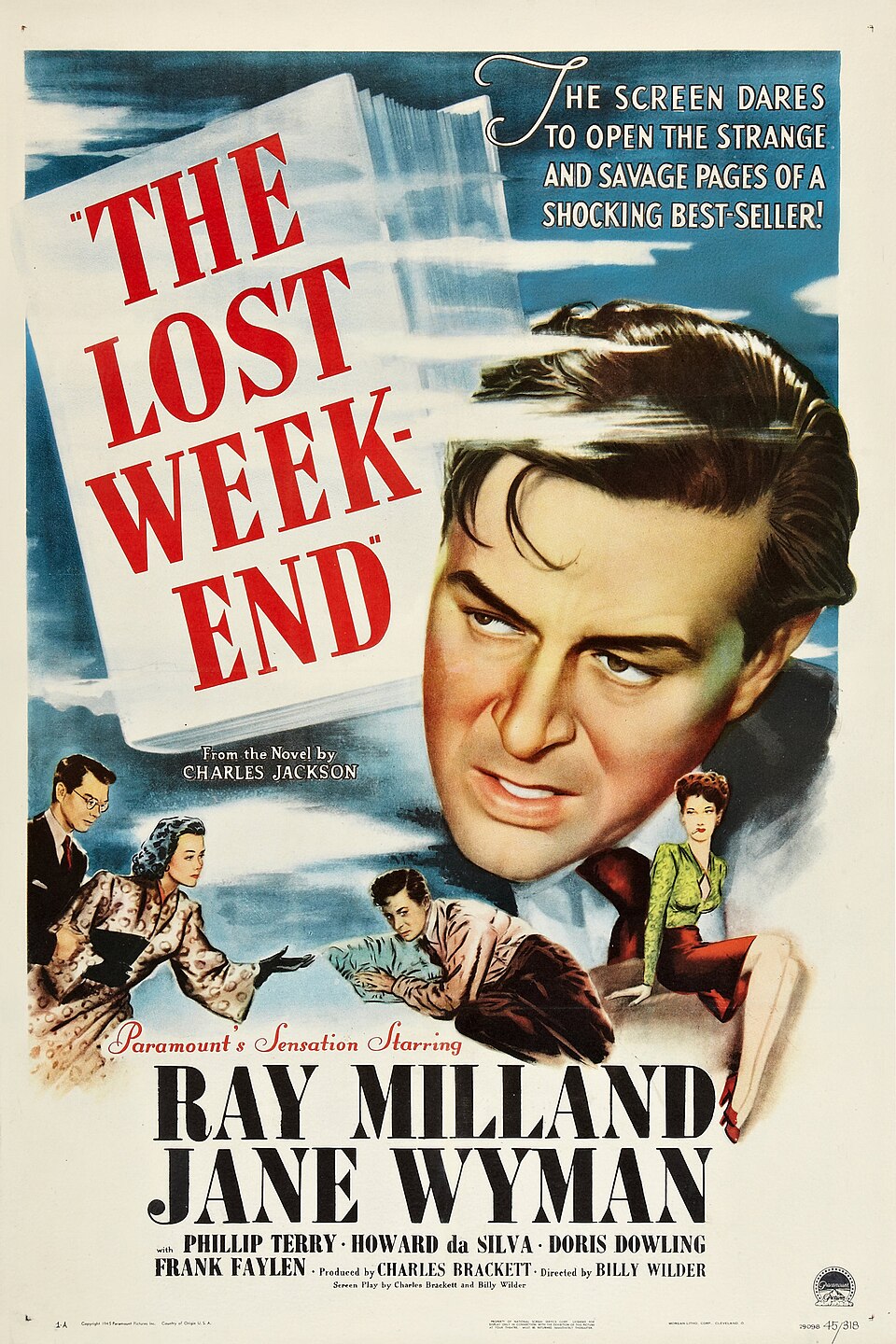

The Lost Weekend
A writer's drinking takes him into a four-day crisis.
- Directed or created by
- Billy Wilder
- Content notes
- A writer's crisis involving alcohol use.
Why this work matters for psychology
The film provides a historical portrayal of alcohol problems to compare with introductory psychology readings.
Psychological connections
Screen stories illustrate how psychological processes look and feel in narrative form; they are not empirical proof or clinical case studies.
Alcohol use at the center of a drama
The writer's four-day crisis offers a prompt for discussing the difference between a dramatic episode and a longer account of substance use.
Interpreting a crisis
What information about relationships, coping, and support would be needed to understand the writer's circumstances beyond the short synopsis?
Portrayal and accuracy limitations
- A dramatic account of a crisis cannot establish how alcohol dependence develops or how treatment works.
Questions to watch for
- 1. What does focusing on four days reveal, and what does it leave out?
- 2. What would a fuller account of long-term support or treatment need to include?
In the Psy101 course
Pair the alcohol-use premise with Section 4.5 (Substance Use and Abuse) and Section 16.2 (Types of Treatment); these sections do not study this film.
- OpenStax Psychology 2e, section 16.2: Types of Treatment
- OpenStax Psychology 2e, section 4.5: Substance Use and Abuse
- OpenStax Psychology 2e, Ch. 4: States of Consciousness
- OpenStax Psychology 2e, Ch. 16: Therapy and Treatment
Textbook links show where these concepts sit in an introductory course; they do not study this screen work. See the full topics and course map.
Companion readings and work source
Readings labeled as conceptual companions or contextual references study the psychological topic rather than this screen work.
- [1](TCM), T. C. M. (1945b). Turner classic movies (TCM) official catalog: The lost weekend. https://www.tcm.com/watchtcm/titles/81891Checked 2026-10-23.Reference catalog checkedCatalog details and an indexed synopsis checked; the full page was region restricted.
- [2]Spielman, R. M., Jenkins, W. J., & Lovett, M. D. (2020). Psychology 2e. OpenStax. https://openstax.org/books/psychology-2e/pages/4-5-substance-use-and-abuse(OpenStax course textbook · Selected passages checked · Checked 2026-10-23).Conceptual Companion (Does Not Study This Work)Conceptual companion: does not study this work. It investigates the underlying psychological construct or textbook topic.Introduces substance-use disorders and groups psychoactive drugs by their behavioral and physiological effects. Its concepts can contextualize portrayals of dependence. Dated legal, policy or treatment examples should not be restated as current advice or used to diagnose a character.Note: Title, objectives, selected beginning/end paragraphs and section headings inspected; full section prose was retrieved, but no whole-section or whole-book read is claimed.
- [3]Spielman, R. M., Jenkins, W. J., & Lovett, M. D. (2020). Psychology 2e. OpenStax. https://openstax.org/books/psychology-2e/pages/16-2-types-of-treatment(OpenStax course textbook · Selected passages checked · Checked 2026-10-23).Conceptual Companion (Does Not Study This Work)Conceptual companion: does not study this work. It investigates the underlying psychological construct or textbook topic.Overviews contemporary psychotherapy and biomedical treatment modalities.Note: Official OpenStax section headings and relevant paragraphs inspected; conceptual companion only, does not study this film.