Back to the directoryFind in the timeline
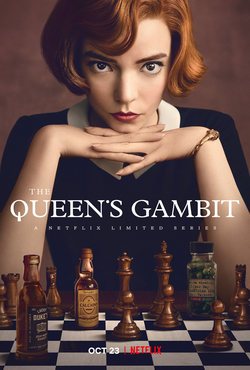

The Queen's Gambit
Co-created by Scott Frank and Allan Scott and adapted from Walter Tevis's novel, this 2020 limited series follows Beth Harmon from a 1950s Kentucky orphanage as she discovers an extraordinary talent for chess while contending with dependence on tranquilizers and a male-dominated competitive arena.
- Directed or created by
- Scott Frank, Allan Scott
- Content notes
- Childhood orphanage placement, tranquilizer dependence, and competitive pressure.
Why this work matters for psychology
By pairing a story of high-level chess skill with institutional childhood loss and substance dependence, the series prompts questions about expertise, gender barriers, and the myth that substances fuel cognitive brilliance.
Psychological connections
Screen stories illustrate how psychological processes look and feel in narrative form; they are not empirical proof or clinical case studies.
Skill acquisition and problem solving in chess
Beth Harmon's rise through competitive chess invites discussion of pattern recognition, practice, and expertise, while distinguishing dramatic genius tropes from cognitive research on skill development.
Substance dependence versus the myth of chemical inspiration
The storyline of tranquilizer dependence alongside tournament pressure raises questions about coping and substance use without suggesting that sedatives enhance complex cognition.
Portrayal and accuracy limitations
- A fictional story combining chess talent and tranquilizer dependence does not show that sedatives improve intellectual performance.
- The drama cannot establish a single cause for expertise.
Questions to watch for
- 1. What evidence does the story offer about practice, social context, and Beth's competitive skill?
- 2. Why is it misleading to equate a character's substance dependence with the source of their intellectual skill?
In the Psy101 course
Pairs the series' depiction of competitive skill and tranquilizer dependence with OpenStax Section 7.4 (What Are Intelligence and Creativity?) and Section 4.5 (Substance Use and Abuse).
- OpenStax Psychology 2e, section 4.5: Substance Use and Abuse
- OpenStax Psychology 2e, section 7.4: What Are Intelligence and Creativity?
- OpenStax Psychology 2e, Ch. 4: States of Consciousness
- OpenStax Psychology 2e, Ch. 7: Thinking and Intelligence
Textbook links show where these concepts sit in an introductory course; they do not study this screen work. See the full topics and course map.
Companion readings and work source
Readings labeled as conceptual companions or contextual references study the psychological topic rather than this screen work.
- [1]Netflix. (n.d.-b). Netflix media center and official title page: The queen’s gambit. https://media.netflix.com/en/only-on-netflix/80234304Checked 2026-10-23.Release or archive checkedSelected official synopsis, credits, or catalog details checked; this does not imply a full viewing.
- [2]Spielman, R. M., Jenkins, W. J., & Lovett, M. D. (2020). Psychology 2e. OpenStax. https://openstax.org/books/psychology-2e/pages/7-4-what-are-intelligence-and-creativity(OpenStax course textbook · Selected passages checked · Checked 2026-10-23).Conceptual Companion (Does Not Study This Work)Conceptual companion: does not study this work. It investigates the underlying psychological construct or textbook topic.Introduces differing accounts of intelligence and creativity, including distinctions among forms of intelligence. The section can frame questions about how screen stories define talent. It does not establish a character’s IQ, diagnosis or the accuracy of a dramatized assessment.Note: Title, objectives, selected beginning/end paragraphs and section headings inspected; full section prose was retrieved, but no whole-section or whole-book read is claimed.
- [3]Spielman, R. M., Jenkins, W. J., & Lovett, M. D. (2020). Psychology 2e. OpenStax. https://openstax.org/books/psychology-2e/pages/4-5-substance-use-and-abuse(OpenStax course textbook · Selected passages checked · Checked 2026-10-23).Conceptual Companion (Does Not Study This Work)Conceptual companion: does not study this work. It investigates the underlying psychological construct or textbook topic.Introduces substance-use disorders and groups psychoactive drugs by their behavioral and physiological effects. Its concepts can contextualize portrayals of dependence. Dated legal, policy or treatment examples should not be restated as current advice or used to diagnose a character.Note: Title, objectives, selected beginning/end paragraphs and section headings inspected; full section prose was retrieved, but no whole-section or whole-book read is claimed.